

What is QSFP28 Optical Module?
The Evolution of QSFP Technology
The QSFP28 represents the fourth generation of the QSFP form factor, specifically designed to support 100 Gigabit Ethernet (100GbE), 32G Fibre Channel, and InfiniBand EDR applications. Building upon its predecessors—QSFP (4x1G), QSFP+ (4x10G), and QSFP14 (4x25G)—the QSFP28 provides four lanes of 25 Gbps each, aggregating to 100 Gbps total bandwidth.
Key Specifications and Form Factor
- Dimensions: Standard QSFP28 form factor (approximately 18.35mm x 72.4mm x 8.5mm)
- Data Rate: 100 Gbps (4×25 Gbps lanes)
- Power Consumption: Typically 3.5W-4.5W, depending on type
- Maximum Reach: From 100 meters to 80+ kilometers
- Protocol Support: 100GBASE-SR4, LR4, ER4, CWDM4, PSM4, and AOC/DAC options
QSFP28 Module Types and Applications
1. 100GBASE-SR4 (Short Range)
- Technology: Parallel multimode fiber using 4x25G NRZ
- Wavelength: 850nm VCSEL arrays
- Reach: Up to 100m on OM4 MMF, 70m on OM3
- Best For: Data center rack-to-rack connectivity, leaf-spine architectures
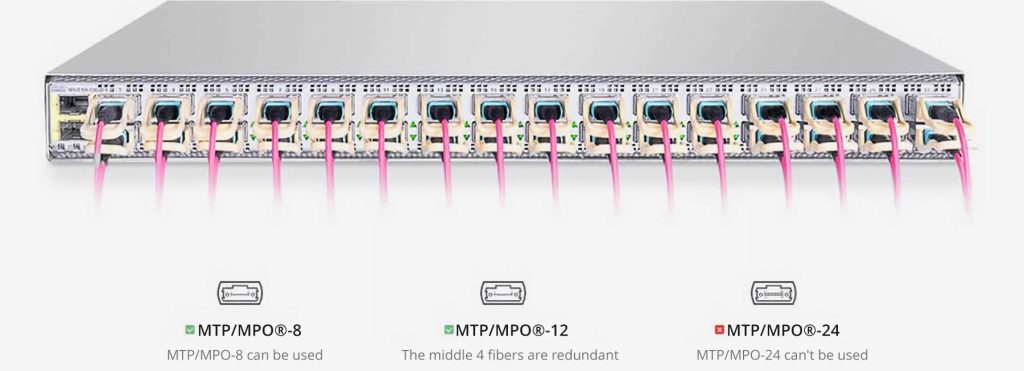
- Connector: 12-fiber MTP/MPO
2. 100GBASE-LR4 (Long Range)
- Technology: Wavelength Division Multiplexing (WDM)
- Wavelengths: 1295.56, 1300.05, 1304.58, 1309.14 nm
- Reach: Up to 10km on single-mode fiber
- Best For: Data center interconnect, campus backbones
- Connector: Duplex LC
3. 100G CWDM4
- Technology: Coarse WDM with 4 wavelengths
- Wavelengths: 1271, 1291, 1311, 1331 nm
- Reach: Up to 2km on single-mode fiber
- Best For: Cost-effective 2km data center connections
- Market Note: Often more economical than LR4 for short distances
4. 100G PSM4 (Parallel Single Mode 4)
- Technology: Parallel single-mode fiber
- Wavelength: 1310nm on all 8 fibers
- Reach: Up to 500m (typically), some versions to 2km
- Best For: Highly parallelized data center environments
- Connector: 12-fiber MTP/MPO
5. 100G ER4 (Extended Range)
- Technology: WDM with higher power lasers
- Reach: Up to 40km on single-mode fiber
- Best For: Metro network connections, extended campus links
6. Active Optical Cables (AOC) and Direct Attach Cables (DAC)
- AOC: Integrated fiber cables with embedded optics
- DAC: Copper twinax cables for very short reaches (<7m)
- Advantages: Lower cost, plug-and-play simplicity
- Best For: Top-of-rack switching, server-to-switch connections
Technical Deep Dive: How QSFP28 Modules Work
Electrical Interface
QSFP28 modules use a 38-contact edge connector that provides:
- Four transmit and four receive differential pairs (25 Gbps each)
- I2C management interface for DDM/DOM
- Module select and reset pins
- Power supply lines (3.3V)
Optical Architecture
The internal architecture varies by module type:
- SR4: Uses VCSEL arrays with 1:4 fiber ribbon cables
- LR4/CWDM4: Incorporates multiplexers/demultiplexers and cooled lasers
- PSM4: Utilizes 8 parallel single-mode fibers (4 TX, 4 RX)
Digital Diagnostic Monitoring (DDM)
All modern QSFP28 modules include comprehensive monitoring:
- Real-time temperature monitoring
- Supply voltage measurement
- TX bias current and output power
- RX input power
- Alarm and warning thresholds
Market Trends and Adoption Drivers
Current Market Landscape
The QSFP28 market continues to grow despite emerging 400G technologies, driven by:
- Cost Efficiency: Lower price per gigabit compared to 400G
- Power Efficiency: Better watts-per-gigabit ratio
- Existing Infrastructure: Compatibility with installed fiber plants
- Breakout Capabilities: 4x25G or 2x50G configurations
Price Evolution
Compatibility and Interoperability
QSFP28 modules work with major networking platforms:
- Cisco: Nexus 9000, 7000, 3000 series
- Arista: 7050, 7060, 7280 series
- Juniper: QFX10000, EX9200 series
- Dell/EMC: Z9100, S5200 series
- HPE/Aruba: 5940, 8360 series
Deployment Best Practices
Pre-Deployment Planning
- Fiber Plant Assessment: Verify fiber type, connector cleanliness, and attenuation
- Power Budget Calculation: Ensure optical power margins meet specifications
- Thermal Management: Consider airflow and cooling requirements
- Compatibility Verification: Test modules with specific equipment models
Installation Guidelines
- Handle with Care: Always use ESD protection
- Connector Cleaning: Use proper fiber cleaning tools before insertion
- Insertion Technique: Align module properly before applying pressure
- Cable Management: Avoid tight bends in fiber cables (minimum bend radius 30mm)
Configuration and Monitoring
- Enable DDM: Configure monitoring thresholds in network OS
- Baseline Establishment: Record initial optical power levels
- Regular Monitoring: Set up alerts for parameter deviations
- Documentation: Maintain records of module locations and serial numbers
Why Choose Tranxoptics for Your QSFP28 Needs?
Unmatched Compatibility and Quality
At Tranxoptics, we specialize in high-performance QSFP28 modules that deliver:
Proven Compatibility: 100% tested on equipment from Cisco, Arista, Juniper, Dell, and HPE
Full DDM Support: Complete diagnostic monitoring capabilities
Performance Guarantee: Meet or exceed IEEE and MSA specifications
Cost Savings: 60-80% less than OEM pricing
Our QSFP28 Product Portfolio
| Product Code | Type | Reach | Fiber Type | Key Applications |
|---|---|---|---|---|
| QSFP28-100G-SR4 | 100GBASE-SR4 | 100m (OM4) | MMF, MTP/MPO | Data center leaf-spine, HPC |
| QSFP28-100G-LR4 | 100GBASE-LR4 | 10km | SMF, LC | DCI, campus backbone |
| QSFP28-100G-CWDM4 | CWDM4 | 2km | SMF, LC | Cost-effective 2km links |
| QSFP28-100G-PSM4 | PSM4 | 500m | SMF, MTP/MPO | Parallel data center networks |
| QSFP28-100G-ER4 | ER4 | 40km | SMF, LC | Metro networks, long-haul |
Technical Support and Services
- Pre-Sales Consultation: Network design and product selection
- Sample Testing: Free samples for compatibility verification
- Deployment Support: Configuration guidance and best practices
- Lifetime Warranty: Industry-leading product guarantee
- Advanced RMA: Next-business-day replacement service
The Future of QSFP28 Technology
Coexistence with 400G and Beyond
While 400G adoption grows, QSFP28 will remain relevant due to:
- Cost Considerations: 100G provides better economics for many applications
- Power Efficiency: Lower power consumption per port
- Breakout Flexibility: Superior flexibility for varied speed requirements
- Infrastructure Investment Protection: Extends life of existing fiber plants
Emerging Applications
- AI/ML Clusters: Interconnect for distributed training systems
- 5G Backhaul: High-capacity mobile network connections
- Edge Computing: Connectivity for distributed edge nodes
- Financial Trading: Low-latency market data distribution
Conclusion: Making the Right QSFP28 Choice
Choosing the right QSFP28 optics involves balancing technical requirements, budget constraints, and future scalability. Whether you need cost-effective SR4 modules for data center deployments or long-range ER4 solutions for metro networks, understanding the technology landscape is crucial.
Key Takeaways:
- QSFP28 offers the optimal balance of performance and economics for 100G networking
- Different module types serve specific distance and application requirements
- Compatibility and quality should never be compromised for cost savings
- Proper deployment and monitoring ensure long-term reliability

