
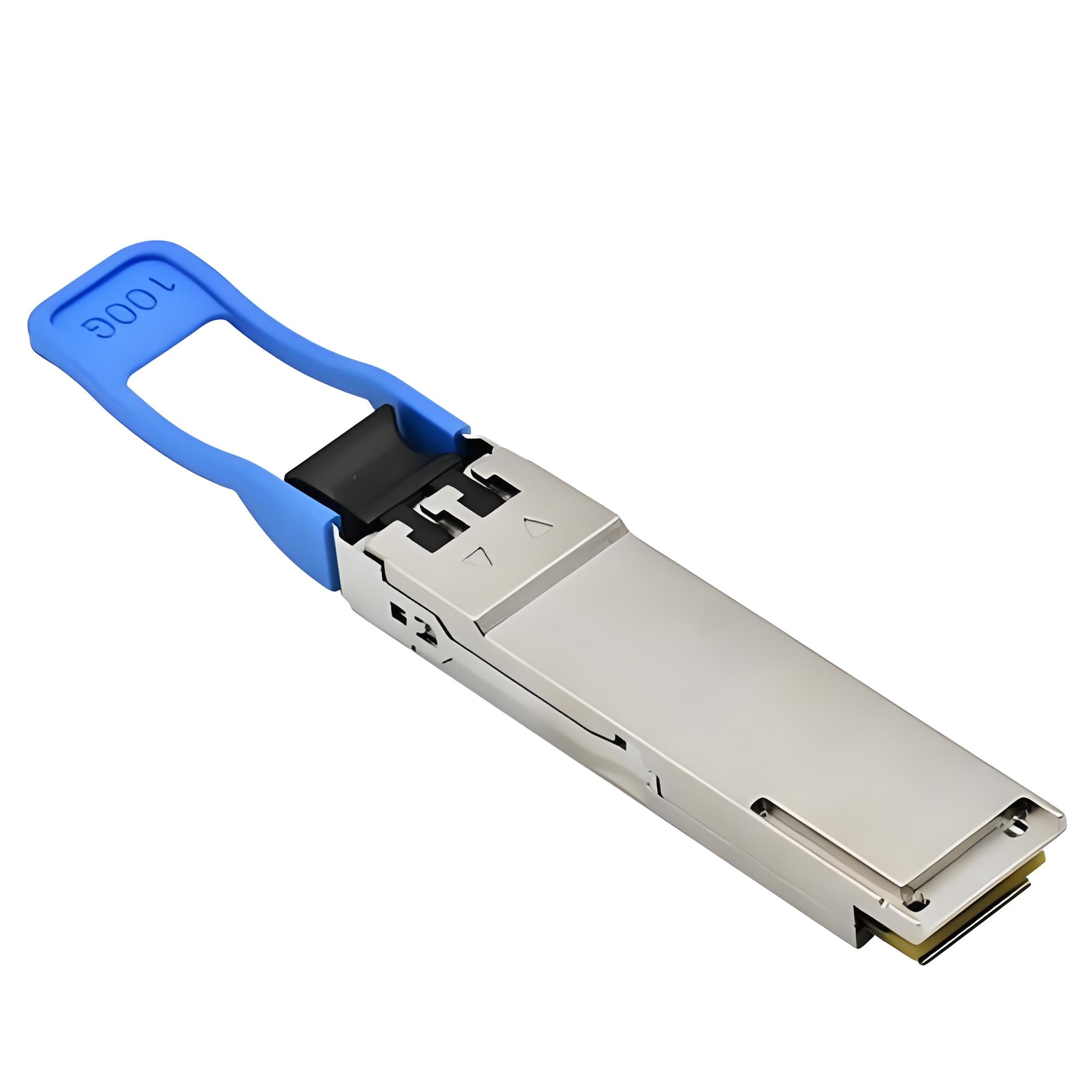
100G Single-Lambda QSFP28 Transceivers: DR1 vs. FR1 vs. LR1
This table compares the key technical parameters of the three primary 100G single-lane (Single-Lambda) optical transceivers for single-mode fiber (SMF).
| Parameter | 100G-DR1 | 100G-FR1 | 100G-LR1 |
|---|---|---|---|
| IEEE Standard | 802.3cd | 802.3cu | 802.3cu |
| Reach (on SMF) | 500 m | 2 km | 10 km |
| Wavelength | 1310 nm | 1310 nm | 1310 nm (LAN-WDM) |
| Modulation | PAM4 | PAM4 | PAM4 |
| Fiber Type | Single-Mode Fiber (G.652) | Single-Mode Fiber (G.652) | Single-Mode Fiber (G.652) |
| Connector | Duplex LC | Duplex LC | Duplex LC |
| Max. Power Consumption | ~2.5 W | ~3.0 W | ~3.5 W |
| Transmitter Technology | DFB | DFB | EML |
| Receiver Technology | PIN | PIN | APD |
| Key Differentiator | Lowest Cost & Power | Balanced Cost & Reach | Longest Reach |
| Primary Application | Server to Leaf Switch (Data Center) | Leaf to Spine / DCI (Data Center) | Campus/Metro Interconnect |
Key Takeaways and Selection Guide
-
100G-DR1: This is the most cost-effective and power-efficient solution for short-reach connections within a data center, such as connecting a 100G server to a top-of-rack (ToR) switch. It offers the lowest price and power consumption but is limited to 500 meters.
-
100G-FR1: This module strikes a balance between cost and reach. It is the ideal choice for data center spine-leaf interconnects and connections between buildings in a campus that are within 2 km. It is more expensive than DR1 due to more stringent optical components.
-
100G-LR1: Designed for longer-distance runs up to 10 km, this module uses higher-performance EML lasers and APD receivers, making it suitable for metro interconnects or large campus backbones. It has the highest cost and power consumption among the three.
Summary: The choice between DR1, FR1, and LR1 is a direct trade-off between reach, power, and cost. For most modern data center applications, DR1 and FR1 cover the vast majority of use cases.


Reviews
There are no reviews yet.