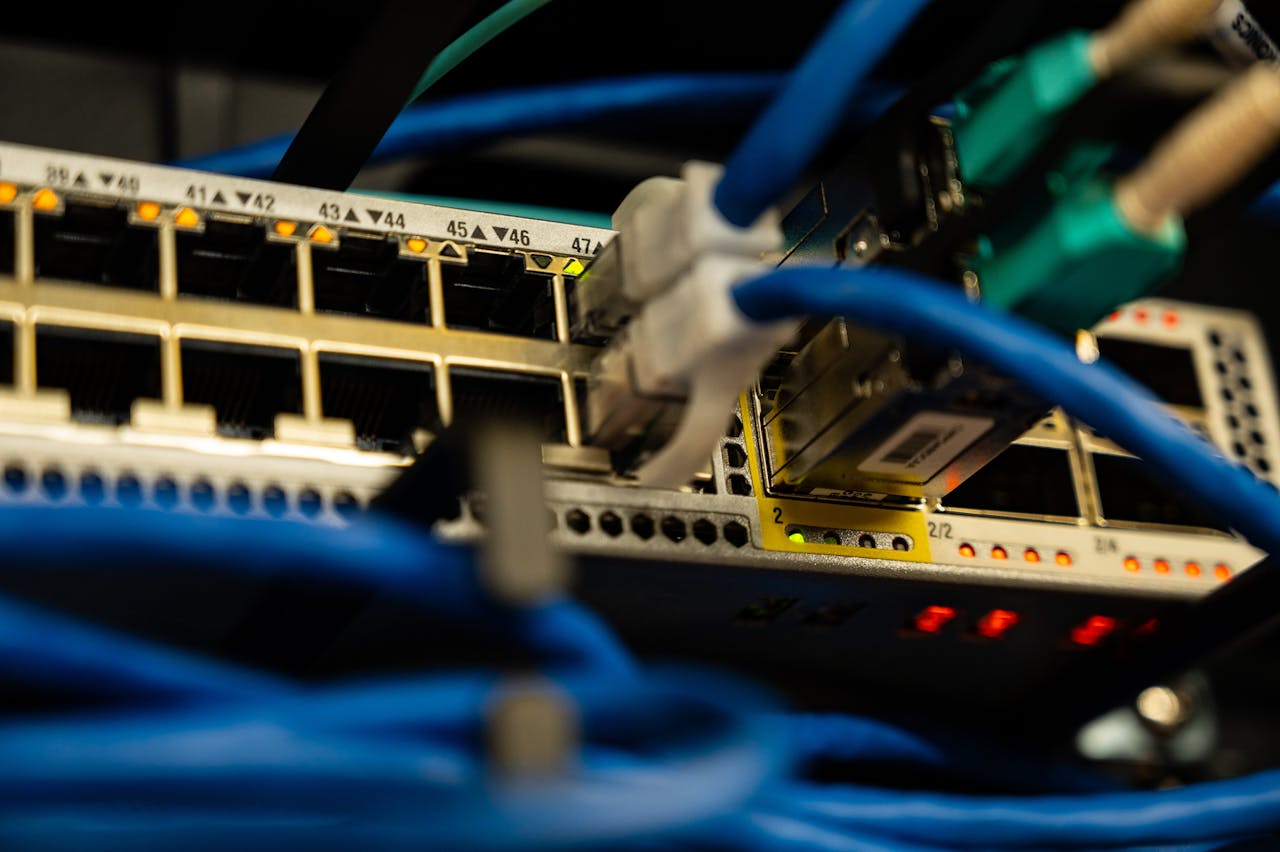
InfiniBand (IB) is a high-speed interconnect technology widely used in high-performance computing (HPC), artificial intelligence (AI) training, and large-scale data centers. It is renowned for its extremely low latency, very high throughput, and excellent scalability, making it particularly suitable for scenarios requiring frequent large-scale data exchange.
Let me introduce InfiniBand technology to you from several key aspects.
🔍 I. Core Features of InfiniBand
The design goal of InfiniBand is to provide powerful I/O capabilities for data centers and high-performance computing.
- Ultra-High Bandwidth & Low Latency:
InfiniBand supports very high data transfer rates. Its evolving standards include SDR (10Gbps), DDR, QDR, FDR (56Gbps), EDR (100Gbps), HDR (200Gbps), NDR (400Gbps or even 800Gbps), and the future XDR (800Gbps+). The end-to-end latency of InfiniBand can be less than 1 microsecond, far surpassing traditional Ethernet (typically 10-100 microseconds). This is crucial for operations like frequent gradient synchronization in AI training. - Remote Direct Memory Access (RDMA):
RDMA technology is one of the core advantages of InfiniBand. It allows one computer to directly access the memory of another computer without involving the operating system. This enables “zero-copy” data transfer, significantly reducing CPU overhead and communication latency. Tests show that RDMA can save over 90% of CPU resources compared to the TCP/IP protocol stack. - Lossless Network & Advanced Flow Control:
InfiniBand creates a lossless network through a credit-based flow control mechanism. The sender only transmits data when it confirms the receiver has sufficient buffer space, fundamentally avoiding packet loss and retransmission. InfiniBand also features Adaptive Routing, which dynamically optimizes data paths to avoid network congestion. - In-Network Computing:
InfiniBand’s SHARP (Scalable Hierarchical Aggregation and Reduction Protocol) technology allows computational operations (like aggregation, reduction) to be performed directly within the network switches, rather than sending all data to the destination for calculation. This can bring significant performance improvements for collective communication operations common in AI training, such as All-Reduce (e.g., NCCL performance can be improved by 1.7x using SHARP in a 400Gb/s network compared to without it). - High Scalability:
InfiniBand’s switched fabric architecture and efficient subnet management allow it to easily support very large-scale clusters. A single InfiniBand subnet can support up to 48,000 nodes, making it ideal for building large AI training clusters and supercomputers.
⚡ II. Evolution of InfiniBand Technology Standards
InfiniBand technology continues to evolve, constantly increasing speed and performance. Here are its main development stages:
| Standard | Speed (Per Port) | Approx. Introduction | Primary Application |
|---|---|---|---|
| SDR | 10 Gbps | Early | Basic connectivity |
| DDR | 20 Gbps | Early | Basic connectivity |
| QDR | 40 Gbps | Early | Basic connectivity |
| FDR | 56 Gbps | ~2011 | HPC, Storage |
| EDR | 100 Gbps | ~2014 | HPC, Early AI |
| HDR | 200 Gbps | ~2018 | AI Training, HPC |
| NDR | 400 Gbps | ~2021 | Large-scale AI Training, HPC |
| XDR | 800 Gbps | Future | Future systems |
Table: Main InfiniBand Technology Standard Evolution
⚖️ III. InfiniBand vs. Ethernet/RoCE
When choosing network technology, InfiniBand is often compared to RDMA over Ethernet (RoCE).
| Characteristic | InfiniBand | Ethernet / RoCE |
|---|---|---|
| Performance | Ultra-low latency (<1μs), very high bandwidth, native lossless fabric | Higher latency (typically microseconds to tens of microseconds), requires PFC/ECN for lossless operation |
| Protocol | Native RDMA support, independent protocol stack | RoCEv2 (RDMA over Converged Ethernet) based on UDP/IP |
| CPU Overhead | Very low, protocol offloaded to NIC, completely bypasses OS kernel | Low, but complexity or congestion can increase CPU burden |
| Scalability | Supports tens of thousands of nodes per subnet, centralized subnet management | Relies on traditional network protocols (e.g., BGP), distributed management |
| Eco-system Compatibility | Dedicated hardware (NICs, switches), not directly interoperable with Ethernet | Based on ubiquitous Ethernet infrastructure, good compatibility |
| Cost | Dedicated equipment, higher initial procurement and deployment cost | Higher cost-effectiveness, can leverage existing infrastructure, more options |
| Key Advantage | Ultimate performance, lossless network, stability/reliability, tailored for HPC/AI | Versatility, compatibility, lower cost, rich ecosystem |
| Typical Use Cases | Large-scale AI training clusters, HPC, financial modeling | Enterprise networks, general data centers, cloud services, some AI/storage |
💡 Comparison Summary:
- For pursuing ultimate performance, large-scale deployment, and sufficient budget: InfiniBand is the proven best choice, with clear end-to-end performance and reliability advantages.
- For pursuing compatibility, leveraging existing facilities, cost sensitivity: RoCEv2 is a more flexible choice, but requires careful configuration of lossless Ethernet (PFC/ECN) to approach InfiniBand’s performance.
🚀 IV. Application Scenarios of InfiniBand
InfiniBand’s powerful features make it the preferred choice in several areas with extreme network demands:
- Artificial Intelligence & Machine Learning Training:
This is currently the hottest field for InfiniBand. Training large models requires thousands of GPUs working together, frequently synchronizing massive parameters and gradients. InfiniBand’s ultra-low latency and ultra-high bandwidth drastically reduce GPU communication wait times, allowing more time for effective computation, thus significantly shortening training cycles (e.g., using 200Gbps HDR InfiniBand can be 2-3x faster than 100Gbps Ethernet). NVIDIA’s DGX SuperPOD uses InfiniBand as its high-speed interconnect backbone. - High-Performance Computing (HPC):
Supercomputers solve complex scientific problems (e.g., climate modeling, astrophysics, drug discovery). These applications involve intensive communication between many nodes. InfiniBand is the interconnect for many top supercomputers (e.g., Summit, Sierra). A significant proportion of systems on the TOP500 supercomputer list use InfiniBand as their interconnect. - High-Performance Storage Networks:
InfiniBand is often used to connect high-performance storage systems (e.g., SAN), providing compute nodes with extremely low latency and high bandwidth storage access, ideal for I/O-intensive applications. - Financial Industry:
In scenarios like high-frequency trading (HFT), where microsecond or even nanosecond latency differences are critical, InfiniBand’s ultra-low latency makes it the ideal choice.
🔮 V. Future Development of InfiniBand
InfiniBand technology continues to evolve:
- Increasing Speeds: The trend towards 800Gbps (XDR) and higher speeds is clear, to meet the needs of future larger AI models and computing clusters.
- Integration with DPUs: Deep integration with NVIDIA BlueField series DPUs (Data Processing Units) to further optimize data center infrastructure, offloading more functions (networking, storage, security) to the smart NIC, freeing up the CPU.
- Continuous Performance Optimization: Although Ethernet RoCE technology is also developing rapidly, for the foreseeable future, InfiniBand, due to its native design advantages, will likely maintain its lead in ultra-large-scale AI and HPC scenarios with extreme performance requirements.
💎 VI. Summary
In summary, InfiniBand is a network interconnect technology built for ultimate performance. Through features like RDMA, lossless networks, ultra-low latency, ultra-high bandwidth, and in-network computing, it provides powerful capabilities for key workloads like AI training and high-performance computing.
Although its dedicated hardware and relatively high cost may not suit all scenarios, for applications where network performance is a core competitive advantage, investment in InfiniBand is often justified. It is like the “super highway” within the data center, ensuring massive data flows at extreme speeds without obstruction.